Menu Engineering 2026: How to design a menu that increases your average ticket by 20%
Javier Estévez
Editor at Mennu
"Have you ever thought your menu is just a price list? If so, you're leaving money on the table with every service."
In modern hospitality, where margins are increasingly squeezed by raw material inflation, cooking well is not enough. You need to sell better. This is where Menu Engineering comes in—a science that combines psychology, data, and design to influence what your customers order.
In this article, we break down how to apply menu engineering in 2026 and why digital QR menus are the secret tool to execute this strategy successfully.
What exactly is Menu Engineering?
Menu engineering is the strategic study of the profitability and popularity of dishes on your restaurant's menu. The goal is not just for customers to eat, but to subtly convince them to order the dishes that give you the highest profit margin.
💡 Key fact: A classic Gallup study showed that a customer spends an average of 109 seconds reading the menu. You have less than two minutes to capture their attention.
The Boston Matrix: Classifying Your Dishes
Before redesigning anything, you need data. You must cross two variables for each dish on your menu: Profitability (Revenue - Cost) and Popularity (Times ordered).
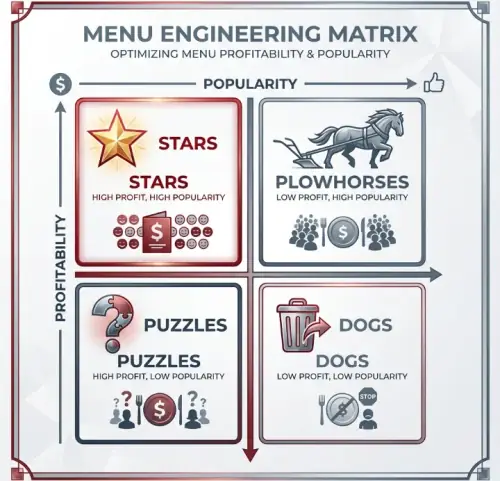
⭐ 1. The Stars High Profitability, High Popularity
These are your best dishes. People love them and they make you great money.
Strategy: Don't touch them! Give them maximum visibility.
🐴 2. The Workhorses Low Profitability, High Popularity
They sell a lot, but you earn little from them.
Strategy: Slightly raise the price or reduce the cost.
🧩 3. The Puzzles High Profitability, Low Popularity
Your hidden gold mine. Profitable but nobody orders them.
Strategy: Urgent marketing. Improve the name, add a photo.
🐕 4. The Dogs Low Profitability, Low Popularity
Nobody likes them and they don't make money.
Strategy: Remove them from the menu.
5 Psychological Tricks to "Hack" the Customer's Decision
In 2026, the trend is Gastronomic Neuromarketing. Apply these tricks to your menu:
1. The Golden Triangle
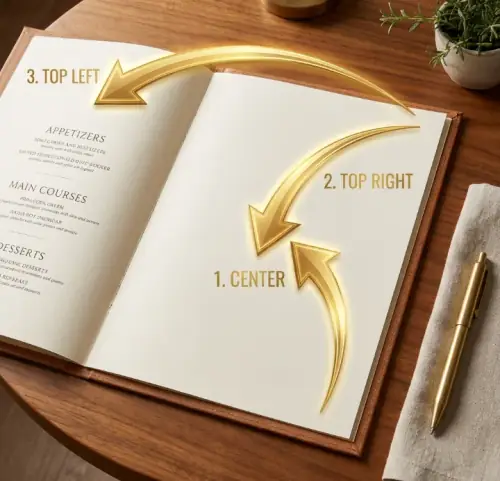
The human eye doesn't read linearly. On a menu, the gaze typically goes first to the center, then to the upper right corner, and finally to the upper left.
Tip: Place your "Star Dishes" and "Puzzles" in these hot zones.
2. Remove the Currency Sign and Decimals
Seeing "€24.00" activates pain receptors in the brain associated with spending. Simply seeing "24" or "24.5" is perceived as less aggressive.
3. The Decoy Effect
If you want to sell a €25 wine, don't place it alone. Put it next to a €45 one. By contrast, the €25 wine will seem like a "reasonable option".
4. Evocative Descriptions
A University of Illinois study proved that detailed descriptions increase sales by 27%.
5. Photography is Everything
In a digital QR menu, you can (and should) include high-resolution photos. A dish with a great photo sells up to 30% more.
Why the Digital QR Menu is Superior to Paper
This is where technology changes the rules of the game. Traditional menu engineering was static. If you printed 50 menus with an error, you lost money.
A/B Testing: Test different prices on a Friday night and measure results instantly.
Instant Highlights: Surplus salmon? Create a chef's suggestion in seconds to move it.
Turn Theory into Practice
You have the keys to menu engineering. Now you need the tool to apply them effortlessly. Create your optimized digital menu in minutes.
Create my Menu Now